
.webp)
Office costs comparison 2026: Classic office or coworking?
Coworking vs. classic office 2026: Based on specific figures, this article shows why classic office space is often more expensive than expected. A realistic comparison of office costs for companies with around 20 employees — including hidden costs, contract risks and modern flex office alternatives.

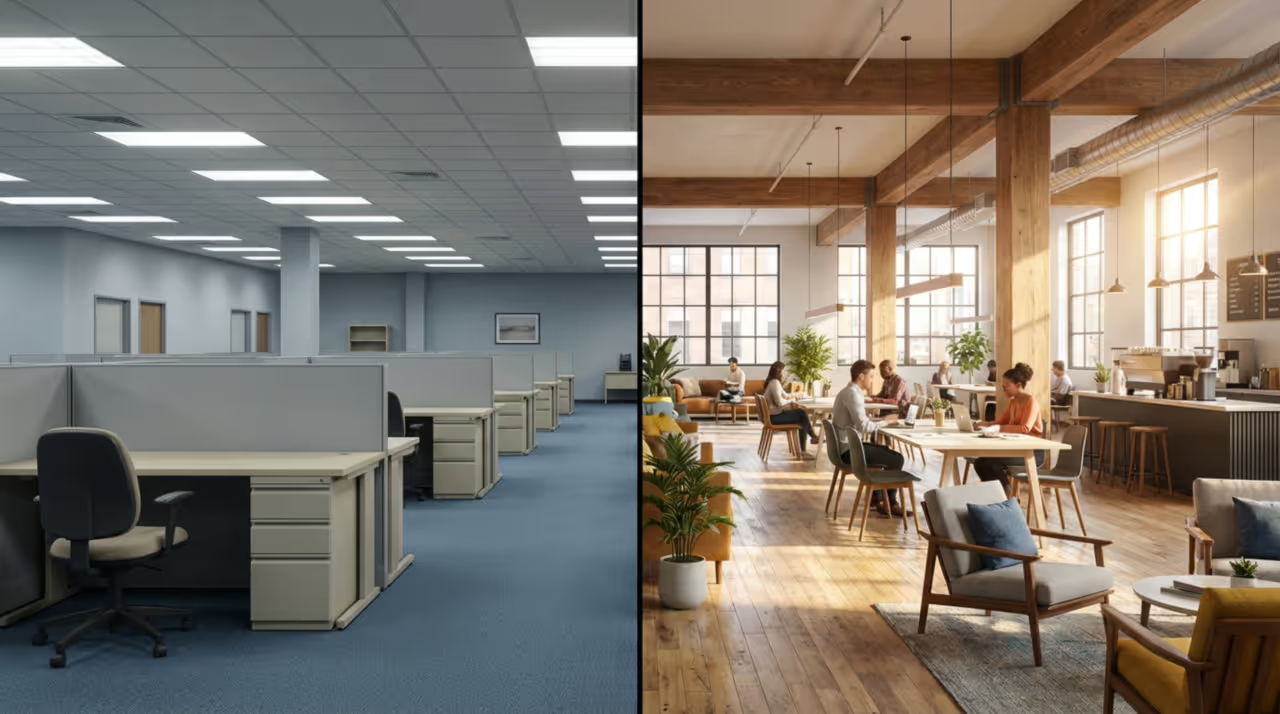
Office Cost Comparison 2026: What Does a Classic Office Really Cost?
A realistic office cost comparison in 2026 shows one thing very quickly:
Choosing an office is no longer just a question of rent, but a fundamental business decision.
Many companies still compare offices based on price per square meter.
In practice, however, real office costs are driven by operations, commitment, investments and time.
This article shows what classic offices and coworking models really cost in 2026, based on concrete numbers, realistic assumptions and clear differences.
Why companies need to calculate differently in 2026
Work models have changed.
Teams work in hybrid setups, grow faster or shrink on short notice.
What remains are long term lease contracts, high fixed costs and office space that is not permanently used.
This is exactly where the cost problem of classic offices begins.
More information on this can be found here.
The cost trap of a classic office
On paper, a classic office in Berlin costs around 27 to 28 euros per square meter.
This number suggests predictability, but it only reflects part of the reality.
In addition, there are ongoing costs for:
- Ancillary costs excluding electricity
- Electricity and energy
- Property management fees
- IT infrastructure and cabling
- Cleaning, reception and office management
- Maintenance, fire protection and mandatory inspections
- Coffee services, meeting rooms and daily operations
- Legal reviews
- Dismantling obligations
In practice, total monthly costs amount to around 18,500 to 20,000 euros
for a company with 20 employees using approximately 300 square meters of office space.
These costs apply regardless of how intensively the space is actually used.
Ancillary costs 2026: The underestimated second rent
While base rent is often fixed, ancillary costs are increasingly becoming a risk factor.
Operating costs now account for a significant share of total office expenses.
Energy, insurance, maintenance and labor intensive services continue to rise, often independent of actual usage.
An empty desk does not reduce ancillary costs.
An unused meeting room still costs money.
Especially in high quality office buildings, technical complexity further increases running costs.
One time costs that are rarely planned honestly
In addition to ongoing costs, classic offices require significant one time investments.
Typical items include:
- Tenant fit out and space adjustments
- Technology, cabling and IT
- Furniture and equipment
- Planning, project management and relocation
- Legal costs for contract review
- Acoustics
Depending on the condition of the space, these costs can quickly reach several hundred euros per square meter.
For an office of 200 to 300 square meters, this often means
50,000 to 100,000 euros in capital commitment before any work actually starts.
This capital is then unavailable for growth, hiring or product development.
Contract terms as a cost risk
Classic office leases bind companies for long periods of time.
Contract terms of five years or more are still common.
Early adjustments are usually not possible
or can only be implemented at additional cost.
If team size, work models or market conditions change,
the cost structure remains unchanged.
Internationally, a clear trend can be observed:
Companies aim for shorter commitments and lower risk.
The German market is following this trend with some delay, but clearly.
Time to productivity: Time is a cost factor
A classic office is rarely usable immediately.
Between signing the contract and productive work, there is often a long phase that includes:
- Search and negotiation
- Construction and renovation
- Furniture setup and IT installation
- Testing, adjustments and coordination
This phase often lasts several months.
Based on our experience, at least six months is realistic.
During this time, costs already occur while productivity and focus remain limited.
Coworking and Flex Office 2026: A different cost model
Modern coworking and flex office concepts follow a different logic.
Instead of ownership and expansion, the focus is on usage and predictability.
In the same example, monthly fixed costs amount to around
12,600 to 12,700 euros
for 20 dedicated workstations.
These costs include:
- Furniture
- Internet and IT
- Cleaning and daily operations
- Meeting room allowance
- Reception and on site service
- Community management
- Lounges
- Events
One time investments are almost completely eliminated.
Spaces are ready to move in and usable immediately.
The real cost difference
When both models are compared realistically, the result is clear:
- 6,000 to 7,000 euros lower monthly costs
- No capital commitment
- No fit out or dismantling costs
- Significantly lower organizational effort
The difference is not the price per square meter,
but the structure of office costs.
Office Cost Comparison 2026:
Classic Office vs Coworking at a Glance
Flexibility as an economic advantage
Coworking and flex offices allow companies to
Adapting areas to real use.
When teams grow, jobs can be expanded.
When structures change, costs can be reduced.
This principle prevents
that payment is made permanently for unused land.
Professionalism: An Outdated Prejudice
Coworking is often associated with open, noisy spaces.
The reality of 2026 is different.
Modern providers offer:
- lockable, own offices
- Access controls and postal service
- high-quality conference rooms
- representative design
It is not the company that adapts to the space
but the company's space.
International developments as a guide
The same trend is evident in many markets:
- reduced presence in the office
- falling utilization of classic areas
- increasing need for flexible additions
Companies are responding
by reducing fixed surfaces and adding them flexibly.
This development is not a lifestyle trend,
but a response to costs, uncertainty and new work realities.
For whom is which model really worthwhile?
A classic office is worthwhile if:
- Team size remains stable in the long term
- A high degree of individualization of the area is necessary
- long-term capital commitment is consciously accepted
Coworking or flex office is worthwhile if:
- Team size fluctuates or grows
- Fixed costs must remain predictable
- Quick deployment is more important than ownership
This difference does not determine square meters,
but through cost control and entrepreneurial flexibility.
Conclusion: Realistically evaluate office costs 2026
A cleaner Office costs comparison shows:
Traditional offices often cost more than expected —
not through rent, but through structure, commitment and time.
Coworking and flex office are not temporary solutions,
but economic models with clearly calculable costs.
Get my case study:
👉 Comparison: Traditional Office Space vs. Coworking (PDF)
Let's find your new Flex Office

Related posts


CoWorking Capital is a comparison portal for flex offices, business centres and coworking spaces with personal expert advice. We help companies across Germany evaluate office offers clearly, make well-founded decisions and find the right office.
