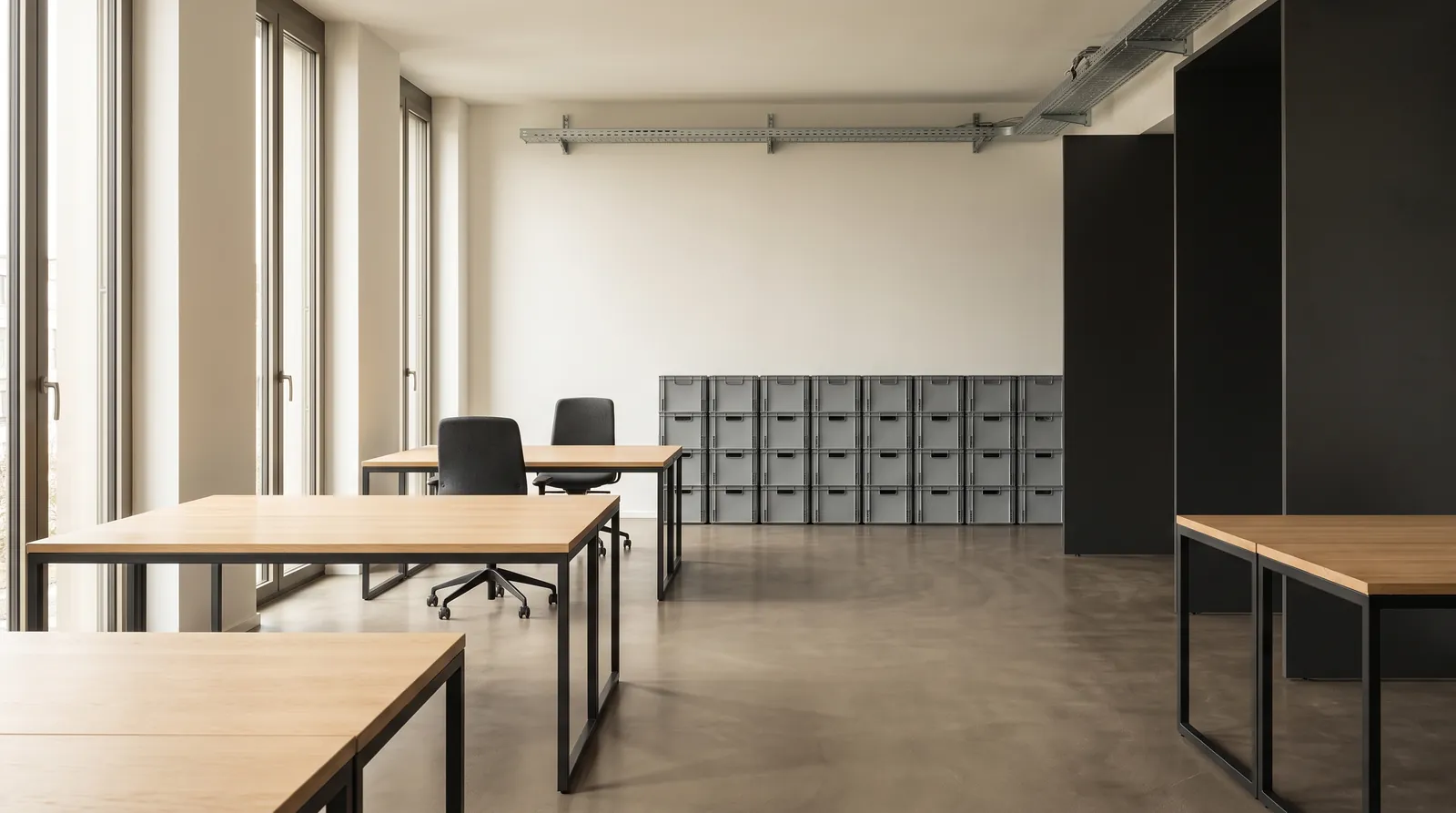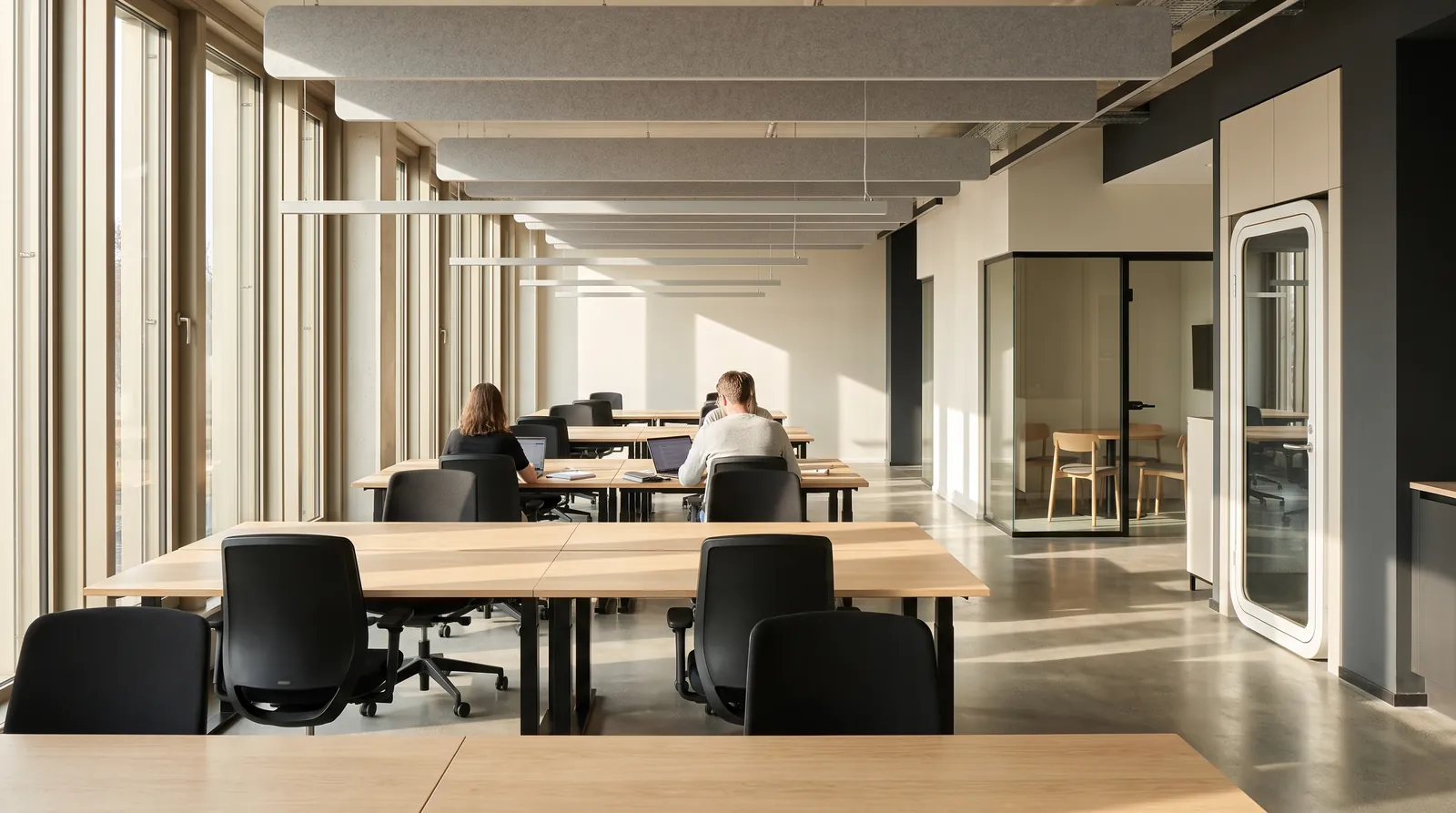
Hot desking means nobody on the team has an assigned desk. Every seat is open to everyone, and whoever shows up takes one. It pays off as soon as desks are occupied well below half the time on average — which is now the normal state of German offices.
How far below is measurable. The Desk Sharing Index 2026 from the workplace platform deskbird puts average desk utilization across 283 companies in Germany’s eight largest cities at 31 percent. Two out of three desks sit empty on an average working day — and are still paid for, heated, and cleaned.
That makes hot desking one of the few measures that visibly lowers office cost without anyone having to relocate. It is also one of the concepts that most often goes wrong, because it gets imposed as a savings programme instead of being calculated as a space model.
What hot desking actually means
The terms get mixed up constantly in practice. That is not pedantry — the models differ in how much planning certainty they leave people, and that determines whether the change is accepted.
| Model | What it means | Seat secured in advance? |
|---|---|---|
| Hot desking | All seats open, no reservation, first come first served | No |
| Desk sharing | Umbrella term: fewer desks than people, managed by a ratio | Depends on setup |
| Hoteling | Seat is booked in advance, like a hotel room | Yes, by booking |
| Activity based working | Seat chosen by task: focus zone, team table, phone booth | No, but fit for purpose |
| Assigned desk | 1:1, the desk belongs to one person | Yes |
Hot desking is therefore the most radical form of desk sharing: no assigned seat, no reservation, no allocation. That is the simplest to administer and the hardest socially. Anyone wanting a gentler transition almost always ends up at hoteling — desk sharing with booking.
The second distinction that matters: hot desking governs who a seat belongs to. The hybrid office concept governs when people are there. Only together do they produce a defensible space plan — neither works alone.
How many desks you really need
The key metric is the desk ratio: workstations divided by people. At 0.7, ten people share seven desks. Which ratio is realistic cannot be copied from a benchmark — it can only be derived from your own attendance pattern.
The German averages from the Desk Sharing Index 2026 set the frame:
| Metric | Germany | What it implies |
|---|---|---|
| Average desk utilization | 31 % | Arithmetically a ratio around 0.4 would carry |
| Peak days (Tue and Wed) | 36 % each | The peak day sets the ratio, not the average |
| Weakest day (Fri) | 19 % | On Fridays four in five desks are empty |
| Office days per week | 1.31 | Zurich 1.58, Vienna 1.56, Paris 1.40 |
The most important point is not in the table: the ratio follows the peak day, not the average. Setting a ratio of 0.35 against 31 percent average utilization reliably produces people walking the floor on Tuesdays and Wednesdays without finding a seat. That is where hot desking fails in practice — not on the idea, but on a ratio built from the wrong number.
What works: measure the peak day, add a buffer of ten to fifteen percentage points, and that is your ratio. At 36 percent peak utilization you land near 0.5 — well below 1:1, but far above what the average suggests.
It is also striking how much the values differ by location. Frankfurt am Main leads at 37 percent desk utilization, followed by Hamburg at 34 and Cologne and Munich at 32 each. At the other end sit Stuttgart at 28, Düsseldorf at 27 and Leipzig at 26. A single group-wide ratio therefore misses the mark at several sites by definition. Frankfurt even breaks the national pattern: there the strongest day is not Tuesday but Monday, at 42 percent.
The gap between policy and reality
This is where it gets interesting. For the study Adaptive Spaces — 2026 Global Workplace & Occupancy Insights, the real estate firm CBRE found that 96 percent of organizations now have a defined office policy. The most common standard within it, at 66 percent: at least three days a week in the office.
What is measured in Germany is 1.31 days.
CBRE names the discrepancy directly too: 70 percent of companies report that employees are in the office less often than leadership expects or mandates. Planning your space against the policy rather than against measured attendance means planning for roughly double the actual need.
The rest of the CBRE figures show the market already drawing the conclusion. Desk sharing there is no longer a future topic but standard: 69 percent of companies surveyed say more than 40 percent of their workforce shares desks. Most work with a moderate ratio between 1.01 and 1.49 people per workstation. And 57 percent of corporate real estate teams expect a footprint reduction within three years, with 67 percent citing lower demand from hybrid models as the main reason.
“In over nine years in the market I have never seen a hot desking project fail because the idea was wrong. The ones that failed were those where the ratio came from the weekly average. Ten seats short on Tuesdays — and after three weeks nobody talks about space efficiency any more, only about the seat shortage.”
Fabrizio Lauria, Founder of CoWorking Capital
When hot desking works — and when it does not
Hot desking is not a concept you can spread evenly across a company. It depends on how unevenly attendance is distributed across the week, and how tightly a workplace is bound to hardware or confidentiality.
| Situation | Fit | Why |
|---|---|---|
| Team with two identical office days | Poor | Everyone arrives at once — the ratio saves nothing but creates bottlenecks |
| Team with staggered office days | Good | Utilization smooths out across the week |
| Sales, consulting, field roles | Very good | Attendance is structurally low and irregular |
| Engineering with fixed hardware setups | Poor | Two monitors, dock, peripherals — setup time eats the gain |
| HR, legal, finance | Limited | Screen visibility and confidential calls need enclosure |
| Shift work or multiple time zones | Very good | Time separation creates the ratio by itself |
The key implementation point follows from the table: hot desking rarely works company-wide, but almost always works department by department. A sales team at 0.4 next to an engineering team with assigned desks is not a compromise — it is the correct answer to two different usage patterns.
Three further points decide whether the change is accepted. First, storage — one locker per person, not per desk. Second, enclosure: phone booths and small meeting rooms, or every confidential conversation migrates to the stairwell. Third, a clear rule for team days, or every team organizes its own informal seat reservation — leaving you with the drawbacks of both models.
What it means for your floor space
It is tempting to translate a ratio of 0.5 straight into halving the space. That does not add up, for a structural reason: cutting desks means adding something elsewhere.
The market shows exactly that. A further CBRE analysis of office refits reports social space growing by 120 percent. The logic is straightforward: if people come in only to collaborate, they need fewer desks and more places where collaboration actually happens.
Realistically, then, roughly a third to a half of the desk space you save flows back into meeting rooms, phone booths, focus seats, and social area. The net reduction is still meaningful — but a different order of magnitude than the ratio implies. How to work that through concretely is in our article on calculating the office space you need.
A second effect is often missed. Less space does not automatically mean lower cost when the lease still has eight years to run. A footprint reduction only becomes a saving once the contract permits it — through partial termination, subletting, or expiry at the right moment. Introducing hot desking without addressing the contract side improves the space metric, not the balance sheet.
Hot desking without rebuilding anything
There is a route that sidesteps the refit question entirely: in a flex office, hot desking is the standard model, not the exception. Using flex office space instead of your own gets you the booking system, phone booths, meeting rooms, and social space as part of the operation — no investment, no project timeline, and no question of who procures the locker system.
That is particularly interesting when your own utilization fluctuates heavily or the team is spread across a region. For the second case, the hub and spoke model is the fitting structure: a main location for team days, smaller spaces near where people live for everything else.
And if the change should be tested before it gets written into your own lease, a temporary office is the cheaper way to measure the usage pattern for real first. Six months of actual booking data is a better planning basis than any estimate.
CoWorking Capital compares available space across Germany, filters by realistic availability on your target date, and negotiates term and conditions up to signing readiness — commission-free on the tenant side. Location overviews are available for Berlin, Munich, Frankfurt and Hamburg, among others.
Hot desking is ultimately not a question of attitude but an arithmetic problem with a social side condition. The arithmetic is solved by the peak day. The side condition is solved by storage, enclosure, and a rule the team can rely on.
Want to know how much space your attendance pattern actually requires? Talk to us, no obligation and commission-free — we will work it through with you and show you space that fits.