.webp)

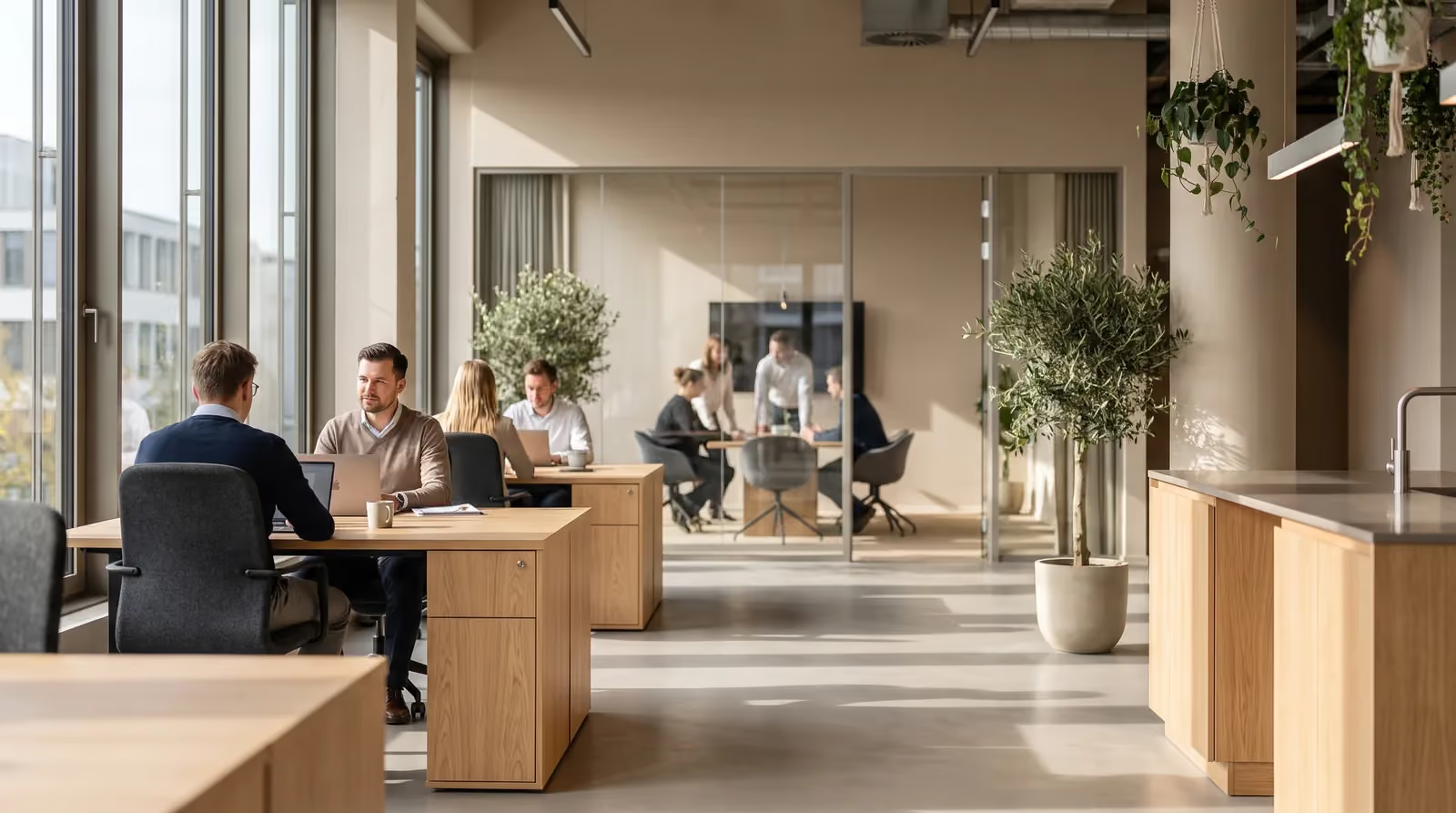
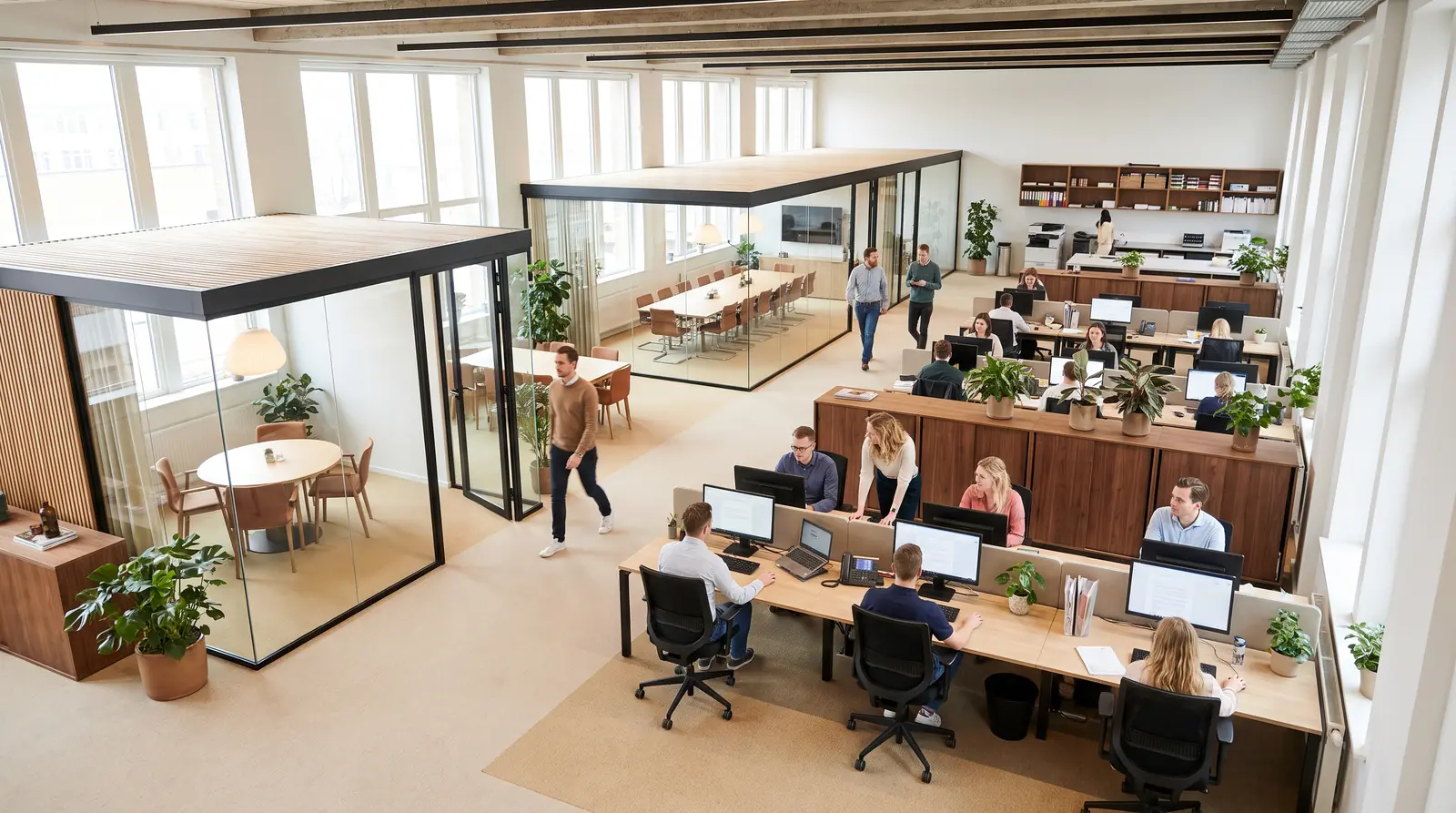
Renting a flex office in Germany today rarely means finding space, it means choosing the right one. A flex office is a furnished, move-in-ready office with a short lease and predictable included services, from a private office to a serviced office to a team room in a coworking space. In Berlin, Munich, Hamburg, Frankfurt, Cologne, or Düsseldorf the supply is large, but the differences are in the details: lease terms, notice periods, included services, fit-out level, access hours, and scalability. That is exactly where it is decided whether a solution is genuinely flexible or gets expensive later. This guide shows you, in the right order, how to compare your needs, the market, and the terms, which mistakes to avoid, and when independent support is worth it.
The German flex office market is big enough that choosing is the real problem: according to the German Coworking Federation (2024 statistics), the number of coworking and flex locations grew by 51.2 percent between 2020 and 2024 to 1,917 locations across more than 600 cities. JLL expects around 30 percent of office space to be used flexibly by 2030. More supply does not automatically mean the right space, though, it means more options you have to compare carefully.
What does renting a flex office actually mean?
Renting a flex office means using a fully operated office for a limited time instead of signing a traditional, long-term commercial lease. The term is used loosely in the market. For some providers it is a furnished private office with a short lease. For others it is a serviced office with a reception, meeting rooms, and an all-inclusive model. Others mean team rooms in coworking spaces, which are quick to access but do not suit every company when it comes to data protection, branding, or quiet.
For decision-makers, the label matters less than the actual operating logic of the space. How quickly can the team move in? What is included in the price? Can the space grow or shrink within three months? Are there special termination rights, minimum terms, or hidden extra costs? A seemingly cheap offer can, on a second look, be far less flexible than a more expensive but cleanly structured model.
When you compare locations, you should always check flexibility in three dimensions: time, space, and contract. Time means short lead times and quick usability. Space means the setup can grow or shrink with the team. Contract means the lease term, notice, renegotiation, add-on services, and liability. For a detailed comparison of a traditional lease versus a flexible space, see our guide Office or flex office.
Which companies benefit from a flex office?
A flex office pays off above all where headcount, time horizon, or team size are still in motion. Not every company needs maximum flexibility, but many need it at specific moments, and that is exactly when a traditional lease is often too slow or too rigid.
Startups benefit when headcount and funding are still moving. A flex office lowers the entry barrier because furniture, basic IT, and operating services are often already in place. That saves time and ties up less capital. Growing SMEs frequently use flexible offices as a bridge, for example after a hiring spike, during relocations, or while renovating. For this group, availability is not the only thing that matters, so does whether several team sizes can be accommodated within one building.
Project teams and corporate units often need space in a specific city at short notice without immediately signing a long-term lease. Here, speed is what counts most. When a team has to be operational within two weeks, a flex office is often the only realistic solution. Hybrid organizations are increasingly turning to flexible offices too, not on principle, but because they find office attendance harder to plan. A company with high occupancy only two or three days a week needs different space models than one with daily full occupancy.
What mistakes should you avoid when renting a flex office?
The most common mistake is looking only at the monthly price per workstation. It seems comparable, but it rarely is. Some offers include meeting-room credits, cleaning, reception, printing, internet, drinks, and 24/7 access. Others bill exactly those items separately. Without a clean comparison, a low price quickly looks better than it actually is.
The second mistake is a vague definition of your needs. If it is not clear internally whether you need ten fixed workstations, two focus rooms, one boardroom, and daily client meetings, the search drags on unnecessarily. Providers respond far more precisely to clear briefs. Third, contract review is often underestimated. In the flex segment especially, the details hold the relevant points: automatic renewals, price escalations, liability questions, deposits, rules for extra seats, or conditions for branding and alterations. Whoever checks these points only just before signing loses negotiating room.
How do you find the right flex office? Step by step
The best route to the right flex office is a clear process in three steps: first define your needs, then compare the market honestly, then negotiate the terms actively. Whoever follows this order finds a workable solution even under time pressure.
1. Define your needs before looking at offers
The best search process does not start with portals, it starts with a short, solid requirements brief. How many people should move in immediately? How many in six or twelve months? Do you need a private office or a lockable unit with meeting rooms? Is a prestigious address important, or is functionality the priority? Then come the operational questions that are often forgotten: are dogs allowed, does the team need bike parking, do guests need to be received professionally, is there a lot of phone work, is sound insulation critical, is weekend access needed? These points often determine usability more than the square footage.
2. Compare the market honestly
Across Germany there is a wide range of flex office providers, from standardized business centers to design-led coworking concepts to high-end serviced-office buildings with individual space solutions. Not every provider fits every company culture, and not every brand is strong in every city. A good market comparison therefore weighs not only location and price, but also operator quality, response speed, space availability, contract logic, and expansion options. For companies with multiple locations, it is also relevant whether a provider can deliver consistent standards nationwide or whether each city has to be solved separately. You can get a city-by-city overview through our spaces in Berlin, Munich, Frankfurt, and other cities.
3. Negotiate terms actively
Many companies assume prices in the flex segment are fixed. That is not the case. Especially with team sizes, lease terms, special requests, or short-notice occupancy decisions, there is often room to negotiate. And it is not always about price. Free months, additional meeting-room credits, free upgrades, reduced deposits, or more flexible termination rules are frequently worth more economically. Keeping several suitable options in play in parallel clearly improves your position. The key is to make offers comparable on substance, not on the surface.
A simple grid to make offers truly comparable
Instead of lining up workstation prices, it helps to use a simple grid that makes the economically relevant levers visible. Just four dimensions are enough to separate a seemingly cheap offer from one that actually fits.
| Check point | What to look at | Why it matters |
|---|---|---|
| Included services | Meeting rooms, cleaning, reception, internet, power, drinks | Decides the real total cost, not the list price |
| Term and notice | Minimum term, renewal, special termination, escalations | Determines how flexible the space stays as things change |
| Scalability | Extra seats, a larger unit in the same building | Saves an expensive move when you grow or shrink |
| Operator quality | Onboarding, response time, support under load | Makes the day-to-day, not the photos in the brochure |
Answer these four points honestly for each offer and you quickly see which model is the cheapest and most flexible in real use.
What does it cost to rent a flex office?
Costs depend heavily on city, micro-location, building quality, and scope of service, which is why the true total cost matters more than the entry price. A private office in a central location in Munich or Frankfurt works out differently than a team room in Leipzig or Essen. On top of that comes the operator strategy: some price aggressively at entry and earn on add-ons, others work with a higher all-inclusive rate and clearer total costs.
The true total cost includes the deposit, contract commitment, extra seats, meeting-room use, IT requirements, parking, branding, out-of-hours access, and possible costs when you grow or shrink. A flex office can look more expensive than a traditional lease, and on the pure price per square meter it often is. Operationally it can still be cheaper, because fit-out, furniture, technology, operations, and time are already accounted for. Especially over short to medium time horizons or with uncertain space planning, that is a real advantage. For how flex costs compare to a traditional lease, see our analysis What an office really costs in 2026.
What matters more: location, operator, or design?
Location and operator matter more day to day than the nicest office, because they decide usability and reliability. Nice photos sell space quickly, but in operation other factors count. How reliable is the operator during onboarding? How professionally are issues resolved? Do the internet, access system, meeting-room management, and guest service work under load too? Is there headroom in the building when the team grows?
A good location also has to fit real use. For recruiting, a central, urban setting can make sense. For back-office teams, a slightly less prominent location with a better price-performance ratio can be the smarter choice. If you are searching nationwide, do not start from city names but from commutes, proximity to clients, and team habits. That supply density varies strongly by region is shown by JLL's coworking distribution figures: Berlin leads with around 305,000 sqm of flex space, ahead of Munich with about 213,000 sqm and Frankfurt with around 146,000 sqm.
When is it worth getting support with your flex office search?
Support is worth it as soon as several cities, tight timelines, or demanding contract questions are involved, because the search then quickly costs too much internal time. That is exactly the point where a specialized, independent market comparison makes sense. It condenses offers, checks fit, structures viewings, and improves your negotiating base.
What is especially relevant for companies is that the search support is not tied to a single operator. Only then does an honest comparison emerge. An independent, commission-free partner on the tenant side can assess offers neutrally and also tell you when a supposedly flexible solution is in fact too rigid for your needs.
“Whoever wants to rent a flex office does not need a longer search process, but a clearer one. In over nine years in the German flex and coworking market, I have rarely seen a case where the lowest workstation price was also the best decision in the end. What matters is contract logic, scalability, and an operator who delivers day to day.”
Fabrizio Lauria, Founder of CoWorking Capital
CoWorking Capital supports searches like this across Germany, independently and commission-free, and that is exactly where the practical value lies: fewer internal loops, better terms, and more certainty all the way to a signature-ready contract.
Conclusion: the right decision is rarely the fastest option on the portal
Whoever wants to rent a flex office in Germany does not need a longer search process, but a clearer one. When needs, comparison, and negotiation are set up cleanly, you can find a solution even under time pressure that not only works right away but still fits in six months. That, in the end, is real flexibility, not the shortest lease term, but the better decision.
Looking for a flex office or coworking space in Germany, advised independently and commission-free? Get free advice now and receive a fitting shortlist including prices within 24 hours.