.webp)


A team grows faster than planned, the current lease still runs 18 months, and the new branch should ideally open next week. Exactly in situations like this the advantages of coworking for companies become concrete. The short answer: the biggest benefit lies not in a single point, but in the combination of fast availability, contract flexibility, ready-made infrastructure, predictable costs, and lower investment risk. Companies do not just buy square meters, they buy time, the ability to act, and often less risk.
Many decision-makers still associate coworking with freelancers and small startups. The market has long moved on. Today mid-sized companies, project teams, consultancies, sales units, and corporations use flexible space too, when speed, scalability, and low internal friction matter more than a classic 10-year lease. How much the market has grown is shown by the German Coworking Federation (2024): up 51.2 percent to 1,917 locations between 2020 and 2024. JLL expects around 30 percent of office space to be used flexibly by 2030.
Coworking for companies: advantages that count day to day
Especially in growth phases or with uncertain headcount forecasts, flexibility is decisive. Whoever needs 18 workstations today but maybe 30 or only 12 in six months needs a model that moves with that. Classic office leases are often too slow for this. Coworking and flex offices fit much better. The most important advantages at a glance:
| Advantage | What it concretely delivers |
|---|---|
| Availability | Ready to move in fast instead of months of lead time |
| Flexibility | Space and term grow or shrink with you |
| Cost & effort | Avoided one-off costs, less internal load |
| Infrastructure | Furniture, IT, meeting rooms, reception from day one |
| Risk | Less capital tied up in space that no longer fits |
| Employer branding | Central, professional workplace instead of a stopgap |
Ready to go faster than with classic office space
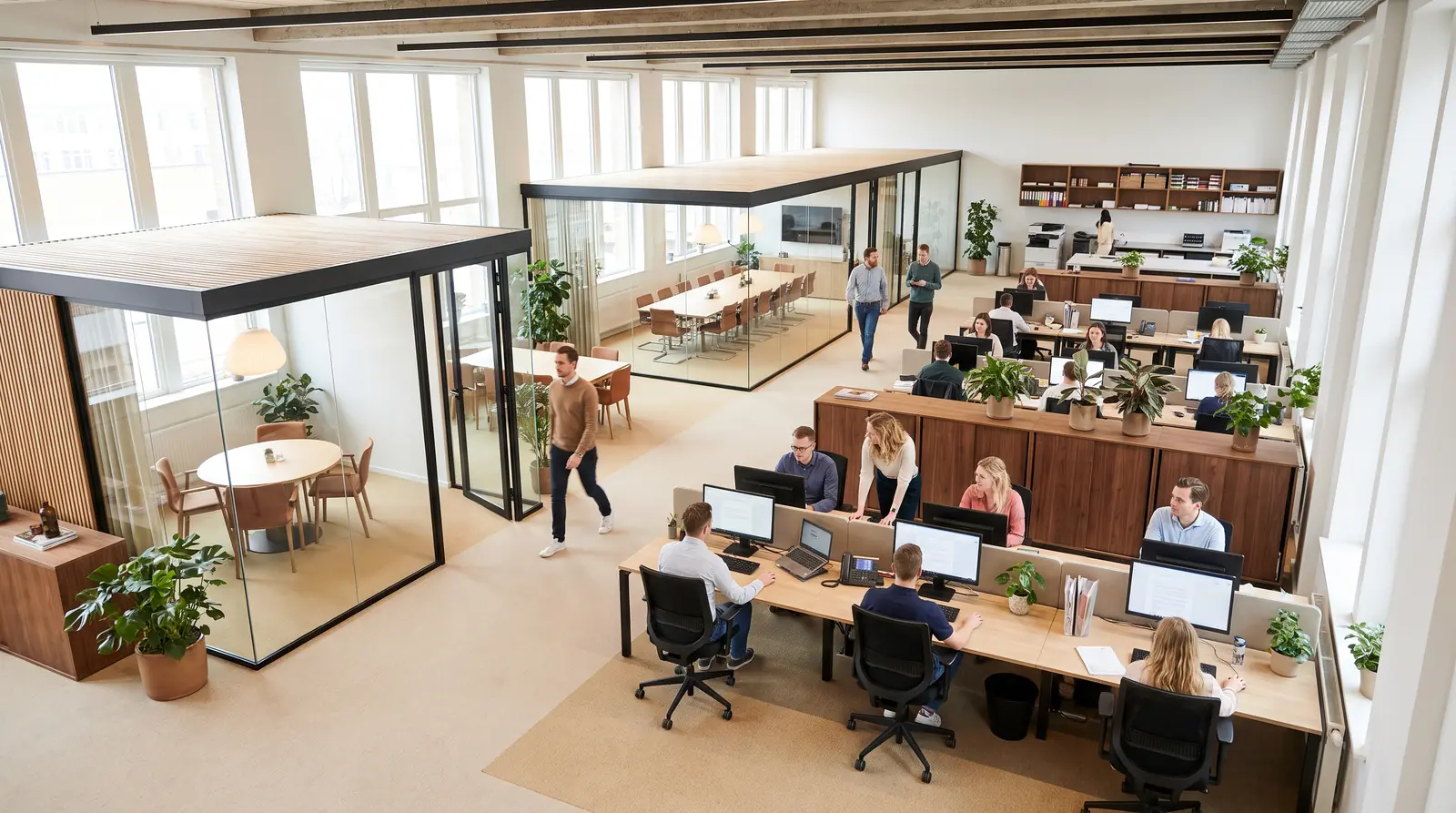
A key advantage is availability. Flexible office space is in many cases ready to move into at short notice. Furniture, internet, meeting rooms, reception, coffee zones, and often basic IT infrastructure are already in place. That saves not only weeks or months in implementation, but also reduces coordination loops with fit-out, procurement, and facility management. For companies with a new location need, this is often the difference between plan and delay. Whoever needs a sales team in Munich, a project office in Frankfurt, or a transitional solution in Berlin becomes operational much faster with a fitting flex model.
More flexibility in team size and term
The second central point is contract flexibility. Classic leases usually offer longer commitments, high upfront investment, and little room for space adjustments. In the coworking context, shorter terms, variable workstation counts, and modular space models are far more common. This is especially relevant for three constellations: growing teams, project-based organizations, and companies in transformation phases. When headcount planning, hybrid model, or location strategy are not yet settled, flexible space is often the more sensible economic decision.
Flexibility does have its price, though. Calculated per square meter or workstation, flexible solutions can look more expensive than a long-term direct lease. What decides is therefore not the isolated list price, but the total calculation including fit-out, furniture, service charges, operating effort, and the risk of mis-planning. How the models differ in principle is shown in our comparison Coworking or your own office.
Where the cost advantages really arise
Many companies compare only the monthly rate at first. That falls short. The real advantages often lie in avoided one-off costs and lower internal load. Whoever rents a classic space usually has to invest in fit-out, furniture, technology, cleaning, operations, and management. On top come the time costs of the search process, coordination with owners, contract review, and coordinating various service providers. In coworking or a serviced office, much of that is already integrated.
For smaller and mid-sized teams this can be very attractive economically. For larger companies it depends more on the location, the term, and the usage profile. Above a certain size, a private office or a dedicated flex office within a coworking provider can make more sense than open memberships. So it comes down to the actual need, not the category alone.
Predictable service charges and less investment risk
Another advantage is transparency. Many services are bundled into a monthly rate. That eases budget planning and approval processes, especially when a location has to be set up fast. At the same time, the risk of investing in a space that no longer fits six or twelve months later drops. Companies still testing their space strategy buy themselves a piece of agility this way. That is especially relevant for new markets, temporary project teams, or the question of how many employees actually come to the office regularly. The full cost logic is shown in our analysis What an office really costs in 2026.
Infrastructure and professionalism from day one
Coworking is interesting for companies above all when operational readiness counts from day one. A good provider offers not just desks, but a professional environment for client contact, internal collaboration, and daily operations. This usually includes equipped meeting rooms, stable internet connections, phone booths, reception services, kitchen areas, and often access to several locations. For teams with hybrid routines or frequent travel this can be a real added value.
What matters above all is choosing the right coworking format. Coworking today ranges from open, community-oriented areas to lockable private offices and your own team suite, so there is almost always a variant that fits the need exactly. Whoever wants exchange, network, and visibility is well served in the open area. Whoever needs data protection, confidentiality, or a lot of focus time chooses a private space in the same building and still gets the full infrastructure and flexibility. Which form fits which need is classified in our overview of office concepts.
Employer branding and employee experience play in too
Even if hard factors usually decide first, the influence on recruiting and retention should not be underestimated. Good flexible offices are often central, well connected, and offer an environment that looks professional without looking like a stopgap. That helps when employees should be won over not for an interchangeable transitional space, but for a working workplace. Especially with hybrid teams, the quality of the office experience matters. When the office is used only two to three times a week, it has to justify the trip, and good coworking often does that better than a classic space.
Coworking for companies: advantages depend strongly on the need
The biggest lever lies in choosing the right coworking format, not in whether coworking fits at all. Whoever books a very open space although the team needs quiet and confidentiality does not use the advantages fully. Whoever plans too rigidly, on the other hand, pays for capacity they do not need. That is why the selection should not start with the question of which provider is currently visible, but in reverse order: how many people use the space regularly? Which functions are indispensable? How sensitive are conversations and data? Are there growth options? Which locations are realistic? How important are corporate design, exclusivity, or 24/7 access?
Only when these parameters are clear can you sensibly judge which coworking variant fits best, from the open space through the serviced office and the business center to the private office in the flex model. The advantages unfold most strongly when space, contract, and usage profile really fit together.
Where the limits lie
In a few cases a classic office lease can be the better choice too, for example with very stable, long-term secured space planning, high customization needs, or special technical requirements. And even then, many flex providers today offer tailored, exclusive team spaces with their own brand control, so the line is far less sharp than it used to be. More important than the category is the precise provider comparison: contract logic, service quality, and room to negotiate differ greatly. What looks comparable at first glance can differ clearly in the detail, for example in meeting-room allowances, extra costs, notice rights, fit-out options, or expansion in the same building.
“Coworking plays its advantages most strongly when space, contract, and usage profile really fit together. In over nine years in the market, the biggest lever was almost never the provider itself, but a clean market comparison before signing.”
Fabrizio Lauria, Founder of CoWorking Capital
The real lever lies in the market comparison
Whoever wants to really use the advantages of coworking for companies should not only search fast, but compare properly. The German flex office market is fragmented. In every city there are different operator structures, price levels, and availabilities, plus differences in incentives, terms, and actual willingness to negotiate. That is why it rarely suffices to look at three websites and book one viewing. A good decision needs a market comparison that considers not only nicely presented space, but also contract reality.
A specialized, commission-free partner on the tenant side like CoWorking Capital can shorten this process substantially, from the needs analysis through a solid shortlist to negotiating better terms. Whoever looks for office space today rarely needs simply a place to work, but a solution that moves with the company, speeds up decisions, and takes operational load out of the process. That is exactly where the relevant advantages of flexible office space lie, not as a blanket concept, but as a strategically fitting answer to a concrete need.
Want to use the advantages of flexible office space for your company without combing through the whole market yourself? Get free, commission-free advice now and receive a fitting shortlist including prices within 24 hours.