.webp)


A private office in coworking is a closed, exclusively used office unit within a flexible office location. It combines two things that are otherwise often negotiated separately: privacy and ready-to-use infrastructure. The topic usually becomes urgent not as a lifestyle question but as an operational decision: a team grows faster than planned, confidential conversations increase, and the kitchen table has long stopped being a solution. For startups, SMEs, project teams, and corporate units this can make a lot of sense, but it does not fit every situation. This guide shows you how to compare your needs, the market, and the terms, and find the space that still fits in six months.
The context is large: according to the German Coworking Federation (2024), the number of coworking and flex locations rose by 51.2 percent between 2020 and 2024 to 1,917 across more than 600 cities, and JLL expects around 30 percent of office space to be used flexibly by 2030. At the same time, according to JLL (Q4 2025), around 8.1 percent of office space in the top-7 cities was vacant. Choosing is therefore the real problem, not availability.
What is a private office in coworking?
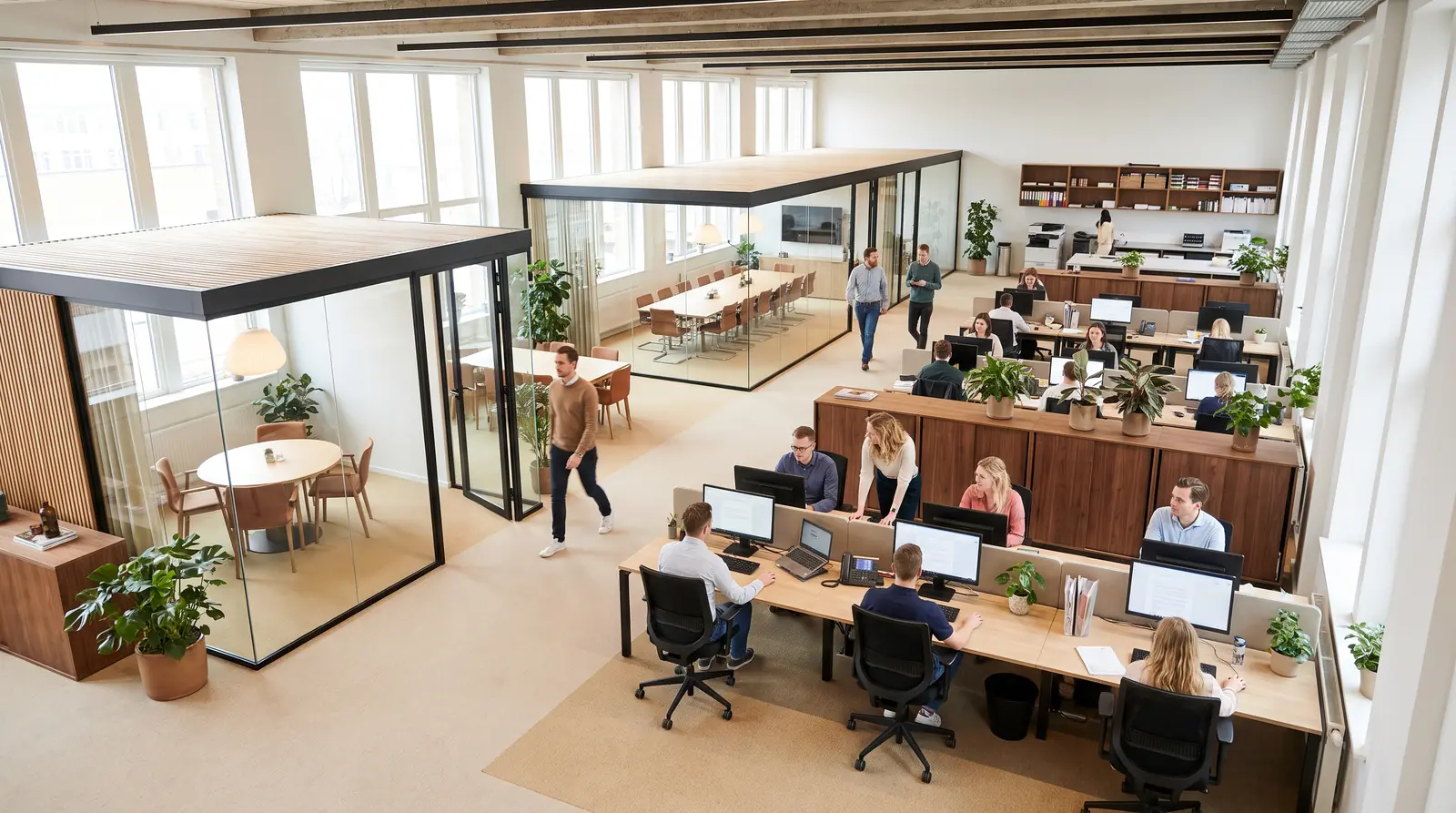
A private office in coworking is a lockable, exclusively used room within an operated coworking location, usually with fixed furniture, internet, access to meeting rooms, community areas, phone booths, kitchen, cleaning, and often reception service. The key difference from a traditional office is the setup: the space is available at shorter notice, mostly fully equipped, and ready to move into with far less internal effort.
Many operators use similar terms for different products, sometimes private office, sometimes team office, sometimes serviced office. For you, what counts is less the label than the actual service.
At the same time there are differences from location to location. Some private offices are acoustically well shielded and suitable for sensitive conversations, others feel more like partitioned team rooms in an open operation. This is exactly where it is decided whether an offer really fits the need or only looks good on paper.
Who is a private office in coworking worth it for?
Most often this model pays off for companies that need speed and do not want to build their own office infrastructure. Whoever has to be operational within a few weeks saves not only time with a flexible private office, but also coordination loops with IT, procurement, facility, and landlords.
The model is especially suitable for founding teams in the growth phase, small and medium companies with 3 to 30 people, temporary project companies, regional satellite teams, and companies testing a new market. It can be interesting for corporates too, when teams need to show presence in a city at short notice without immediately entering a long-term lease.
It fits less well when there are very specific space requirements, such as specialized technical installations, very strict security requirements, or strongly divergent workplace concepts. Then a traditional office or a tailored flex office solution is often the better choice.
What are the advantages of a private office in coworking?
The biggest advantage is speed: many spaces are available at short notice and usable immediately. That reduces downtime, relieves internal teams, and accelerates the operational start. On top of that come predictability, flexibility, and a professional external image.
Predictability arises because instead of many individual services you usually pay one all-in price or a clearly structured package. Rent, service charges, WiFi, furniture, cleaning, and shared areas are often already included. That makes budgets more plannable, even if the price per square meter can look higher at first glance than a traditional lease.
Flexibility brings strategic value: whoever does not yet know exactly how fast a team grows or shrinks can, in many coworking buildings, switch more easily to a larger or smaller unit. This agility is worth more to many companies than a nominally cheaper contract with a long commitment. The professional external image should not be underestimated either: a well-run location with reception, meeting rooms, and a clean service level often comes across far more strongly to clients, applicants, and partners than an improvised stopgap.
Where are the limits?
As attractive as the model is, it has clear limits. The price per workstation is often higher than that of a long-term traditional office if you look purely at the space. The added value comes from service, short terms, and the elimination of your own investments. Whoever does not need these advantages may pay for flexibility that is barely used.
Availability can be an issue too. Especially in sought-after locations, good private offices with 6, 8, or 12 workstations are not always immediately free, and some operators have waiting lists or only interim solutions. Add to that quality in the detail: not every coworking environment is suitable for focused work or sensitive conversations. Meeting rooms can be scarce, phone booths overloaded, air conditioning or acoustics not at the desired level. Whoever only judges the glossy photos quickly makes an expensive wrong decision.
What does a private office in coworking cost?
A blanket figure would be misleading, because price, city, micro-location, operator, contract term, team size, and fit-out level vary strongly. In central locations of Berlin, Munich, Frankfurt, or Hamburg the monthly cost per workstation is naturally higher than in B or C cities. It also matters whether you look for a small two-person office or a larger team unit with a branding option.
What is important is the comparison based on total cost. A seemingly cheaper price quickly loses its appeal if meeting-room allowances are scarce, print costs are billed extra, access is only limited, or setup fees are added. Conversely, a higher monthly price can be more economical when everything is already included. The deciding question is therefore not only what the space costs, but what the ready-to-work workstation costs over the actual usage period. For a detailed cost logic, see our analysis What an office really costs in 2026.
What should you check for a private office in coworking?
The first question is not the location but the real need. How many people actually use the space daily? How often do confidential conversations take place? Is regular client traffic expected? Are there hybrid models with fluctuating occupancy? Whoever does not clarify these points cleanly searches either too big, too small, or in the wrong product category.
| Check point | What to look at |
|---|---|
| Need | Actual daily occupancy, confidentiality, client traffic |
| Location | Accessibility, client proximity, surroundings, recruiting fit |
| Contract | Term, notice, price adjustment, deposit, upgrades |
| Room & tech | Acoustics, internet, ventilation, light, focus areas |
| Occupancy | Real occupancy of shared areas at peak times |
What sounds flexible verbally is not automatically flexible in the contract. Notice periods, minimum terms, price adjustments, out-of-hours access, meeting-room rules, guest reception, and company signage should be crystal clear up front. And a viewing at peak time usually says more about real occupancy than any presentation.
Why does a market comparison save so much time?
The German flex office market is large but not transparent. Two offers with a similar description can be far apart in price, service level, and contract logic, and not every location sensibly accommodates every team size. The actual work therefore only begins after the first online research: checking availability, interpreting floor plans, comparing terms, evaluating add-on services. Whoever does this alongside daily business often loses days or weeks.
A clean market comparison condenses the search process, filters out unsuitable options early, and strengthens the negotiating position. You can get a city-by-city overview through our spaces in Berlin, Munich, and Frankfurt. CoWorking Capital supports companies across Germany commission-free on the tenant side, from needs analysis through the shortlist to viewings and terms negotiation. The advantage lies not only in time savings, but above all in better decisions.
“A good private office does not simply create space. It gives the team a reliable frame in which work is possible right away and growth is not slowed down. In over nine years in the German flex and coworking market, the best space was never the one with the nicest interior, but the one with the cleanest fit to the business model.”
Fabrizio Lauria, Founder of CoWorking Capital
Conclusion: think function, flexibility, and follow-on cost together
The best space is not the one with the fanciest interior, but the one with the cleanest fit to the business model. For a sales team a presentable location with lots of client contact can be ideal, for a product team quiet and focus count more, for a project office term flexibility is often more important than any design feature. When you rent a private office in coworking, think three things through together: function, flexibility, and follow-on cost. Only when all three fit does a fast solution also become a good solution.
Want to rent a private office in coworking, advised independently and commission-free? Get free advice now and receive a fitting shortlist including prices within 24 hours.