.webp)

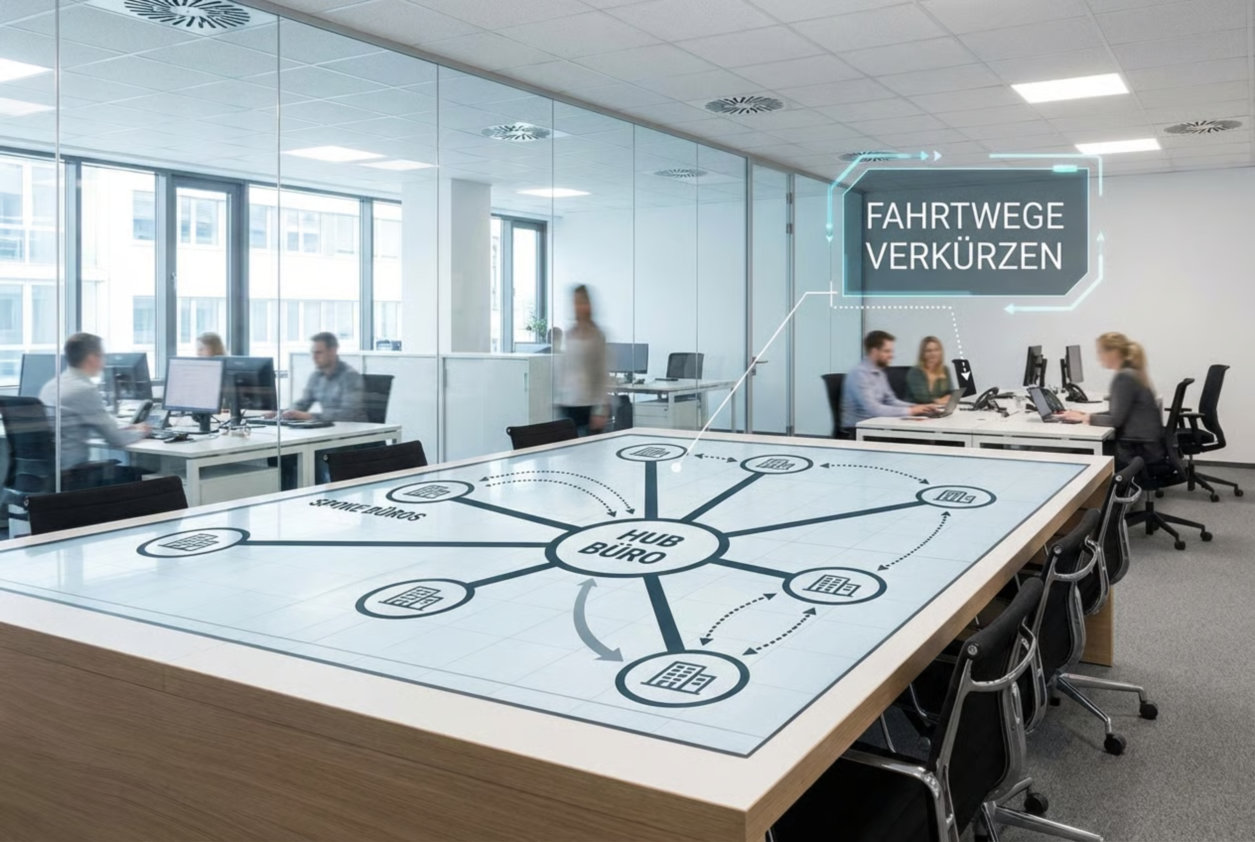
A team commutes across a metro region for two office days a week. At that point the office becomes a location question, not a question of how many desks to buy. The short answer on what the hub-and-spoke model delivers: a smaller headquarters as the hub, plus a network of small, flexibly rented workplaces where people actually live. Not as a replacement for the headquarters but as an addition that brings working reality and location strategy together.
The return to the office is, in many companies, not a return to daily presence. Teams meet for alignment, project work, client meetings, and culture. Focused individual work often happens anywhere. That is exactly where rigid attendance rules fail: the enemy of productivity is rarely the home office, it is the trip to headquarters.
What the hub-and-spoke model means
The traditional model is monocentric: one large headquarters downtown that everyone commutes to. Hub and spoke is polycentric and works like a wheel.
The hub is the reduced headquarters for representation, brand work, and large formats. The spokes are a network of smaller workplaces spread across residential areas or transport nodes. Instead of concentrating 500 people in one place, they work distributed in flexible space near them. That shortens commutes and makes space planning more agile.
What matters is that the spokes are almost always rented flexibly. Signing five ten-year leases in the outskirts misses the point of the model. How flexible space works is explained in our article how a flex office works.
Satellite, touchdown, project site: three types, three contracts
The word “decentralized” is often used too broadly. For the search, what counts is the function a site is meant to serve. Location, contract model, equipment, and budget all follow from that. Mixing the three cases means paying for services nobody needs, or picking space that stops fitting after a few months.
| Type | What for | What it needs | Fitting term |
|---|---|---|---|
| Satellite office | Permanent base for a regional team | Private office, reliable availability, meeting rooms, address for client visits | 12 to 24 months |
| Touchdown site | Occasional focused work, time between meetings | Coworking with day passes, good transport links, phone booths | Monthly or on allowance |
| Project site | Fixed-term mandate, post-acquisition integration, new region | Speed over customization, a clean exit | 3 to 12 months |
The distinction also decides the contract type. A satellite office justifies a longer commitment because availability and address matter. A touchdown site needs the opposite: access rather than space ownership, ideally through memberships or booking allowances. And a project site is about a clean exit — which terms are realistic there is shown in our article on temporary office space.
Commute time, talent and ESG
Why do large companies lose specialists to smaller ones? Often because of flexibility. An example: a developer lives in Potsdam, headquarters is at Potsdamer Platz. That is roughly 50 minutes each way. A flexible workplace in a coworking space in Berlin closer to home brings her down to 15 minutes.
Across two office days that is about two hours of life per week. Decentralized workplaces also widen the talent pool: offering locations outside the centre reaches people who will not travel into the city daily.
Then there is the ESG angle. Employee commuting counts towards Scope 3 emissions. Shortening commutes while reducing floor space in the energy-intensive headquarters cuts the carbon footprint measurably, instead of partly heating a large space that stands empty. Needs-based office space in Munich or Frankfurt can be added flexibly.
Headquarters, home office and satellite compared
Where is the sensible mix? The three options solve different problems and do not exclude each other.
| Criterion | Headquarters | Home office | Satellite office |
|---|---|---|---|
| Primary purpose | Brand identity and culture | Focus, work-life balance | Collaboration without commute stress |
| Cost structure | High, long commitment | Low for the company | Medium and flexible |
| Commute time | Long | None | Short |
| Equipment | Very good | Highly variable | Professional, immediately usable |
| Limit | Not practical for everyone | Little exchange, little culture | Only pays off once used |
When a decentralized network does not pay off
The model is often presented as generally superior. It is not. The calculation tips as soon as sites are too small and too lightly used.
Housing only two or three people at five locations does not produce better terms. It produces five separate contracts with five contacts, five invoices, and five notice periods. Administrative effort grows linearly with the number of sites; the price advantage does not. In those cases, access solutions and booking allowances usually beat several fixed private offices, or a central location with targeted fallback options.
The second limit is utilization. A site with eight desks used on average by two people costs several times the headquarters per actual user. So an honest estimate of simultaneous occupancy belongs before the search, not headcount. How to capture that in a structured way is shown in our guide to defining office requirements, and the space logic behind it in our article on calculating office space.
“In over nine years in the market I have never seen a decentralized network fail on the idea. The ones that failed were those that ended up with five sites of three people each — and nobody knew any more who held which contract where.”
Fabrizio Lauria, Founder of CoWorking Capital
Building a network in four steps
- Build a heatmap. Where do people actually live? Cluster postcodes instead of guessing districts.
- Run a pilot. Book flexible allowances with established providers instead of taking your own space, starting with two or three locations.
- Organize access. Memberships or access passes that let people check in flexibly at offices in Frankfurt, Hamburg, or Stuttgart.
- Review after six months. Scale where demand is real, and pull back where it does not materialize.
The biggest mistake would be skipping step four. A pilot without review quietly becomes permanent, whether or not it works.
Metrics and usage rules
Decentralized workplaces only work when usage is governed. Without clear responsibilities you get double bookings, unused memberships, and arguments about who may use which desk. A lean location policy is enough: it defines the target group per site, the booking route, the cost centre, and how visitors or external project partners are handled.
Four metrics, collected monthly, are enough to steer it:
| Metric | What it shows | Consequence |
|---|---|---|
| Active users per site | Is the location accepted at all? | Below half of those eligible: question its purpose |
| Simultaneous occupancy on the peak day | Is capacity enough on the days that matter? | Persistently above 90 percent: expand |
| Meeting-room hours booked | Is it a meeting point or a desk substitute? | Very low: touchdown instead of satellite |
| Total cost per active user | The only real basis for comparing sites | Outliers: review the contract or close |
After three to six months this shows whether a site should be expanded, reduced, or replaced by another solution. Internal communication matters too: decentralized offices must not land as a hidden attendance requirement. When it is clear what they are for — team days, client work, or focused work near home — acceptance and usage rise. Leaders should live the same rules as their teams. How to make presence rules fair is covered in our article on the hybrid office concept.
With several locations it is also worth comparing whether one operator can offer consistent terms and access across Germany — through a network such as 1000 Satellites — or whether local solutions work out better in total. Which clauses matter most across several contracts is covered in our checklist on reviewing a coworking office contract.
The right decentralized location does not have to be representative at any price. It has to work for the people who will use it and stay manageable for the company. Deciding usage, location, and contract flexibility before the viewing makes the decision faster and keeps it sound beyond the first growth step.
Want to know which locations fit where your people live and when they come in? Get commission-free advice now and receive a location selection including terms within 24 hours.