.webp)


Twelve months of runway, a team growing from eight to 18 people, and suddenly the kitchen table is not enough. Exactly in this phase a flex office for startups becomes interesting, not as a lifestyle topic, but as an operational decision. The short answer: a flex office pays off for startups above all with fast growth, uncertain headcount planning, and market entries, because it delivers speed, liquidity, and responsiveness. Whoever rents too big too early ties up capital. Whoever reacts too late loses productivity, applicants, and often day-to-day pace.
For startups the office is rarely just an address. It is work environment, recruiting factor, infrastructure package, and cost block at once. That is why a sober look at what flex offices really deliver pays off, and at the points where the model is not automatically the best solution for every team.
Why a flex office for startups often fits better than a classic lease
A classic office lease demands one thing above all: predictability over years. That is exactly what many young companies do not have. Headcount, funding, product development, and market entry change faster than a long-term lease allows. A flex office reduces this risk because terms are shorter, spaces more modular, and services already integrated. How flex office and classic lease differ in principle is shown in our comparison Office or flex office.
The biggest advantage lies not only in flexibility, but in speed. Startups usually need no nine-month search process, no in-house fit-out planning, and no individual contracts for internet, cleaning, furniture, or access systems. They need a space that works at short notice and looks professional. On top comes a second point that is often underestimated: liquidity. Whoever does not have to invest in deposits, fit-out, furniture, and a service-charge structure keeps capital in the company. Especially in early growth phases that is often more valuable than the nominally cheaper price per square meter of a conventional office.
What a flex office for startups delivers in practice
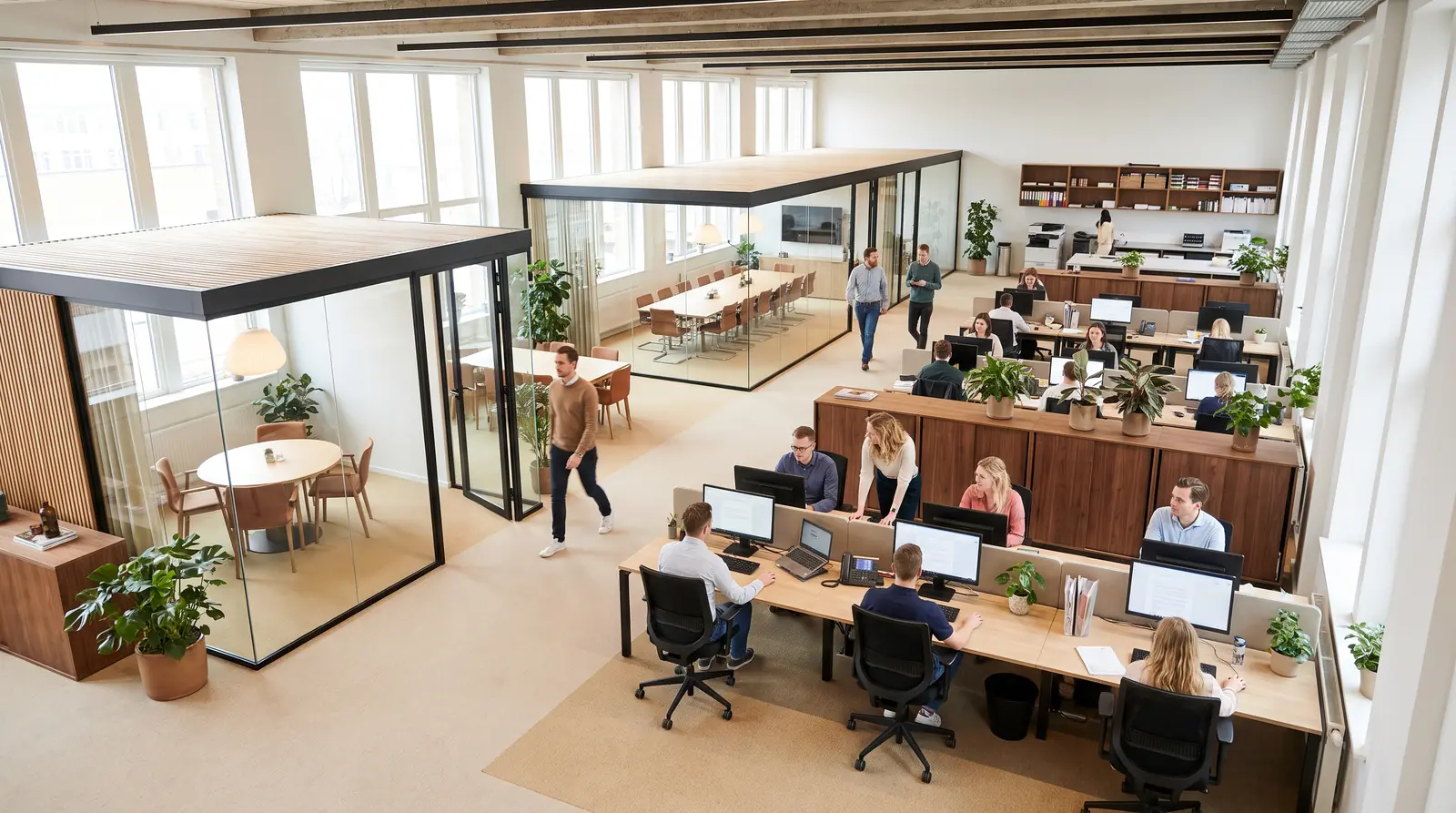
At its core a flex office combines workstation, service, and contract flexibility. Startups rent not just space, but an immediately usable solution. That is especially relevant when there is neither time nor personnel capacity internally for a classic space search. Typically furniture, internet, cleaning, reception services, meeting rooms, and shared areas are already organized. Depending on the provider, 24/7 access, phone booths, event spaces, or scalable extra offices are added. For founders and operations leads this mainly means: less coordination, less lead time, less operational friction. The advantages in detail are shown in our article Coworking for companies.
Still, not every flex office is automatically startup-ready. Some buildings are strongly geared to freelancers or solo self-employed. Others look presentable but are too rigid, too expensive, or unsuitable for confidential team work in daily use. What matters is therefore not the label, but the actual usage model. Which office form fits which need in general is classified in our overview of office concepts.
When a flex office really pays off
The model is especially sensible in three situations. First, with fast growth, when team size is not yet stably plannable over the next six to twelve months. Second, with market entries or new locations, when a professional presence should first be built without immediately entering long-term commitments. Third, in transition phases, for example after a financing round, before a move, or while a company switches from remote to hybrid.
A flex office can become less attractive when a startup is already very stably planned, permanently uses large spaces, and has a clear three-to-five-year horizon. Then a classic office can be more economical. The supposedly higher price in the flex model is therefore not expensive or cheap across the board, it is above all the price for lower risk and higher responsiveness.
Cost: the price is only half the truth
Many teams compare only the desk price or the monthly rent first. That is understandable but falls short. In a flex office numerous services are already included that would have to be budgeted separately in a classic office. Whoever only lines up the base price often compares two very different packages. More important is the total cost view: lease term, notice periods, all-in services, possible setup costs, meeting-room allowances, printing or IT flat rates, and the question of how extra seats are billed. Especially with growing teams the real differences often arise not in the starting price, but in the adjustment costs.
A cheap provider can become expensive when every additional workstation costs disproportionately or meeting rooms constantly have to be rented externally. Conversely, a price that looks higher at first glance can be economically sensible when the team is immediately operational without further investment and does not have to search again when it grows. How the real costs add up is shown in our analysis What an office really costs in 2026.
Location, culture, infrastructure: what startups often underestimate
The best space is of little use if it is not accepted in daily life. For startups, location is not only a question of prestige. It influences commute times, recruiting, client meetings, and the likelihood that teams really use the office. A central location can help attract talent and make appointments more efficient. At the same time, central locations are not always the best choice when budget pressure is high and the team works hybrid. Then a well-connected edge location can be more sensible, provided infrastructure, food options, and accessibility are right.
The building culture also plays a bigger role than many think at first. Some providers encourage exchange and community, others offer quieter, enclosed work environments. For a sales-heavy team with a lot of client contact that can be ideal. For a product team with focus phases and confidential conversations it often needs more privacy and acoustic control. Good flex providers offer both worlds in the same building, so startups do not have to choose between community and focus, but get both.
The most important checks before deciding
Whoever selects a flex office should not rely only on pictures, price sheets, or the first impression. The operational details are decisive. The checklist below helps ask the right questions before signing.
| Check | Why it counts for startups |
|---|---|
| Scalability | How fast can space be expanded or reduced? |
| Team zones | Fixed, connected areas instead of scattered desks |
| Data protection & access | Access control, lockable rooms, confidentiality |
| Meeting rooms | Availability and allowances without constant extra cost |
| Cost transparency | Service charges and extra seats clear and plannable |
| Growth follow-on | Fitting follow-on space in the building or network |
Startups in particular benefit from thinking about the next growth steps. An office for ten people is found quickly. It gets harder when ten become 16 in a short time and the provider has no fitting follow-on solution in the building or network. Then another move looms in the middle of a growth phase. Contract clauses also deserve attention: good flexibility shows not only in the short term, but in fair options to adjust, that is rules for additional seats, notice windows, renewal mechanics, and the handling of special requests. A seemingly flexible model can be surprisingly rigid in the contract.
“For startups it is almost never about the nicest office, but about the one that does not slow growth. In over nine years in the flex market, the most expensive mistake was almost always not thinking about the next six months and then having to move again in the middle of growth.”
Fabrizio Lauria, Founder of CoWorking Capital
How the search for the right flex office for startups runs more efficiently
The most common mistake is a too broad, unstructured search. Berlin, Munich, Hamburg, Frankfurt, or Cologne offer many options, but visibility is not the same as suitability. Whoever works through platforms and provider lists alone quickly loses time and still gets only a slice of the market. The process becomes more efficient when the need is defined clearly first: how many fixed seats are needed today? How many could be added in six months? Does the team need lockable offices, project-based extra space, or only a hybrid solution with core attendance two to three days a week? Only with these answers can you compare sensibly.
After that it is not about as many viewings as possible, but about a clean shortlist. Three to five fitting options are usually enough when they were selected by clear criteria: budget, location, fit-out model, contract flexibility, growth perspective, and cultural fit. This is exactly where the biggest lever arises, not in the quantity, but in the quality of the comparison. If terms are to be negotiated too, market knowledge is decisive. Especially in the flex segment, incentives, pricing logics, and room to move differ clearly by provider and occupancy. For tenants it is therefore helpful to get the market presented neutrally, not just the argument of a single operator. This is exactly where a specialized, commission-free partner on the tenant side like CoWorking Capital supports especially effectively.
A flex office is strong for startups when it solves a business problem: too little planning certainty for classic leases, too much internal search effort, or too much tied-up capital. It is not automatically the best option just because it looks modern or is available at short notice. The right decision arises from the interplay of team structure, growth dynamics, location strategy, and contract logic. In the end it does not count whether the contract says coworking, serviced office, or private office, but whether the space keeps your team in motion instead of slowing it down.
Your team is growing and the kitchen table is not enough anymore? Get free, commission-free advice now and receive a fitting shortlist including prices within 24 hours.