.webp)

Renting a business center in Germany means using a move-in-ready office with bundled services and a flexible term instead of organizing a traditional, long-term lease. Furniture, reception, meeting rooms, internet, cleaning, and often mail handling are already set up. Whoever looks for a business center usually needs not a long market survey but a solid solution in a short time: the team grows, a project launches in a new city, or the current lease no longer matches reality. That is exactly when it shows whether a business center really fits or only looks flexible at first glance. This guide shows you how to compare your needs, the market, and the terms, and find the space that still works in six months.
Choosing is the real problem here, not availability: in Germany's seven major cities, around 8.1 percent of office space stood vacant at year-end, about 8.1 million sqm, according to JLL (office market report Q4 2025). At the same time the flexible market is growing: according to the German Coworking Federation (2024), the number of coworking and flex locations rose by 51.2 percent between 2020 and 2024 to 1,917, and JLL expects around 30 percent of office space to be used flexibly by 2030. More supply, though, means more options you have to compare carefully.
When is a business center in Germany worth it?
A business center is especially strong when speed, predictability, and low internal effort matter more than maximum customization. That applies to startups after a funding round just as much as to mid-sized companies with project teams, international firms entering the market, or corporates with decentralized satellite offices.
In practice we often see four typical scenarios. First: a company needs space immediately because new staff have already been hired. Second: a branch is to be tested without committing for five or ten years. Third: a bridge solution is needed during renovation, refurbishment, or relocation. Fourth: a hybrid working model calls for smaller, more flexible spaces instead of a rigid main lease.
In exactly these cases the model scores with a short lead time. Many spaces are available at short notice, sometimes within a few days. That is a real advantage when internal processes, recruiting, or client projects allow no delay.
What is included when you rent a business center?
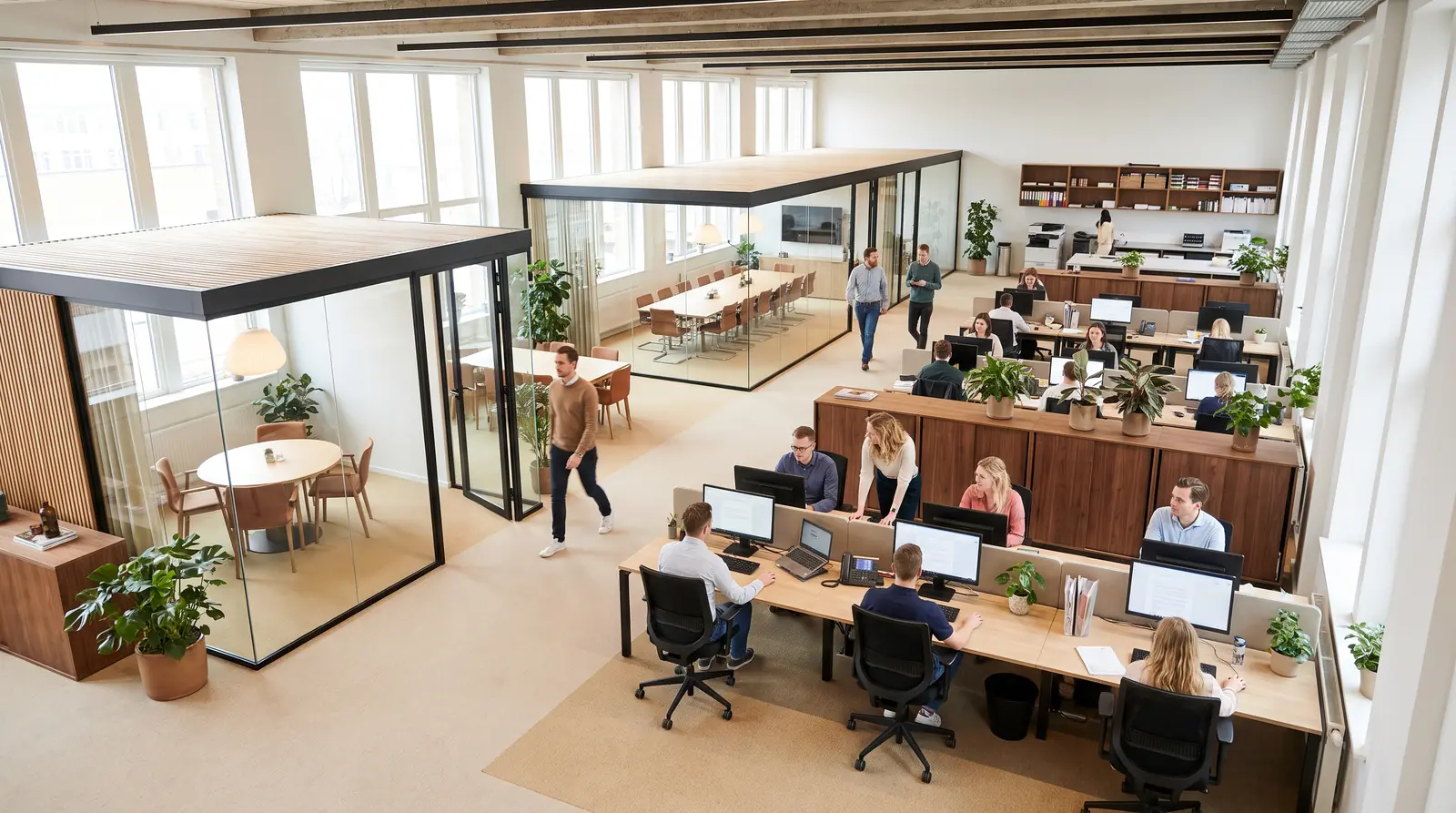
When renting a business center you usually take a lockable private office or office unit within a professionally operated center, including a service package. It typically covers furniture, high-speed internet, shared areas, kitchens, cleaning, service charges, and a professional reception. Depending on the building, telephone service, 24/7 access, IT support, print allowances, or flexible meeting-room use are added.
The term sounds clear but is not always so in the market. Some operators market classic serviced offices as business centers, others combine private offices with coworking areas. For you, what counts is less the label than the actual scope of service.
The big advantage is predictability. Instead of coordinating several contracts for space, fit-out, cleaning, furniture, and infrastructure, you get a largely bundled model that reduces complexity. The downside: the package logic makes price comparisons harder, because services vary strongly by operator.
What are the advantages of a business center, and where is the catch?
A business center suits companies that need working workplaces rather than real-estate build projects of their own. That saves time, creates a presentable address, and reduces entry costs. Whoever has to be operational quickly benefits enormously.
Financially the model can make sense too. Yes, the monthly rent per square meter is often higher than a traditional office. But you avoid high upfront investments in fit-out, furnishing, IT, and operational organization. For many teams the deciding factor is not the pure rent per square meter, but the total cost over the planned usage period.
The catch is in the detail. The shorter the term and the more extensive the service, the higher the price often is. Add to that differences in notice periods, meeting-room allowances, price escalations as you grow, and extra costs for services that sound obvious in the first conversation but are billed separately in the contract. That is exactly why you should not look only at the desk price.
What should you check when choosing?
Location stays the first filter, and not only the city but micro-location, accessibility, recruiting relevance, and proximity to clients. A cheap location outside your search radius can become more expensive in practice if commute times rise or applicants drop out.
Next comes the space logic. Many teams today do not look for a rigid office for three years, but for a solution that can grow or shrink again. What matters is therefore whether extra seats are available at short notice, whether internal moves are possible, and how flexibly the operator reacts to team changes.
Equally important is the contract structure. Term, notice period, deposit, indexation, price adjustments after the start phase, and special termination rights should be checked carefully. In many cases an offer looks cheap because the entry conditions are attractive. Only in the contract details does it show what happens after six or twelve months. The working reality has to fit too: acoustics, meeting-room availability, data protection, visitor handling, and IT security decide whether the space supports daily work or constantly creates friction.
How do you compare offers correctly?
Never look at offers in isolation, but along a few hard criteria. A common mistake is to compare only two numbers: monthly rent and number of workstations. That falls short, because if operator A includes four meeting-room hours per month and operator B twenty, or one location includes cleaning and the other does not, the price difference is only apparently transparent.
| Comparison criterion | What to look at |
|---|---|
| All-in cost | What is truly included, what is billed separately |
| Office sizes & scalability | Extra seats, a larger unit, internal moves possible |
| Term & exit | Minimum term, notice, price escalations, special termination |
| Scope of service | Meeting allowances, reception, IT, cleaning, 24/7 access |
| Location & availability | Micro-location, brand effect, real move-in date |
Equally relevant is the negotiation level. Especially with several available units, longer terms, or financially strong tenants, there is often room to move, for example on rent-free periods, upgrades, additional meeting-room allowances, a cap on price increases, or more flexible exit clauses. Whoever knows the market and talks directly with decision-makers usually achieves better terms than via a pure online enquiry.
Why does the business-center market differ by region?
The German market for business centers is not a single market. In Berlin, Munich, Hamburg, or Frankfurt the choice is large, but so is the spread in price, quality, and operator concepts. In B and C cities the supply is often smaller, but availability and value for money can be more attractive, provided the location is right.
On top of that, business centers are positioned very differently by city. In some markets international operators with standardized packages dominate, in others local providers play their strength of high flexibility. Standardization helps with rollouts across several cities, local operators are often faster on special solutions. For companies with multiple locations, gut feeling does not pay off, but a clean market comparison per region does. What works in Cologne is not automatically the best solution in Stuttgart.
How do you find the right space fastest?
The search becomes efficient when requirements are defined precisely early on: team size, target cities, move-in date, budget range, desired term, meeting-room requirements, corporate standard, and growth options. Whoever states these points clearly saves follow-up questions, wasted viewings, and unnecessary loops.
Then a curated shortlist should emerge from the broad market. Not ten half-fitting options, but a few spaces that truly match budget, timing, and requirement profile. This is exactly where research separates from advice, because a good preselection often cuts the process from weeks to a few days. You can get a city-by-city overview through our spaces in Berlin, Frankfurt, and other cities.
The next step is viewings with a clear evaluation logic. On site, look not only at design and atmosphere, but at space efficiency, confidentiality, occupancy of shared areas, and contractual room to move. A professionally run process does not end at the tour, but in a solid negotiation. CoWorking Capital supports exactly this path across Germany, commission-free for tenants and with a clear focus on better terms, less internal effort, and a space that really works day to day.
“The biggest wrong decision is rarely the wrong city, but the misjudged need. Whoever rents too small pays for stopgaps, whoever plans too big ties up budget unnecessarily. In over nine years in the German flex and coworking market, a business center was always strong when it offers operational flexibility without breaking the economics.”
Fabrizio Lauria, Founder of CoWorking Capital
Conclusion: judge the need right instead of signing the first offer
Whoever has to decide quickly should not simply sign the first offer. Before signing, ask yourself: how likely is headcount growth, how stable is the location strategy, and which functions must the space actually fulfill over the next twelve to eighteen months? A business center is strong when it fits team size, way of working, and time horizon, because a flexible office is only good if it does not become a bottleneck again after just a few months.
Want to rent a business center in Germany, advised independently and commission-free? Get free advice now and receive a fitting shortlist including prices within 24 hours.