
.webp)
A–Z Glossary / Coworking Dictionary
A to Z glossary for coworking and modern working worlds: terms on flex offices, new work, hybrid work and office trends explained simply.

.avif)
A–Z Glossary / Coworking Dictionary: Flexible Offices & Modern Working Worlds
A – Agile Working
A dynamic, adaptable way of working with short iterations and clear goals. Methods such as Scrum, Kanban or OKR support communication, self-organisation and fast decisions. Space planning follows the work: modular furniture, focus, team and creative zones. This creates a working culture that fosters innovation and flexibility over the long term.
B – Breakout Areas
Informal areas for spontaneous meetings, short discussions or creative breaks. They loosen up the working day, encourage exchange and create a deliberately different setting than the fixed workstation. Breakout areas boost creativity and are an important component of modern office design.
C – Coworking
Coworking: Shared, flexible use of office space by independent individuals, start-ups and companies – with community, openness and shared resources.
Coworker: Members of the coworking community who learn from and benefit from one another.
Coworking spaces offer an inspiring environment that facilitates collaboration and lets new networks emerge.
D – Digitalisation
Use of digital technologies for efficient, location-independent collaboration: cloud, booking systems, sensors for space usage, hybrid meeting tools. The goal: simplify processes, use resources optimally, seamless hybrid work. Digitalisation is the basis for the modern, flexible working world.
E – ESG (Environmental, Social, Governance)
Sustainable materials and energy efficiency (E), health/wellbeing and inclusion (S) as well as responsible governance and transparency (G). Flexible spaces help to optimise space requirements and support sustainability goals. ESG thus becomes a decisive factor for future-proof working environments.
F – Flexible Office
Short terms, scalable space, immediate move-in readiness (furnished, IT ready). Companies adjust capacity quickly and avoid over- or under-provision. Flexible offices are a valuable advantage especially for growing or project-oriented teams.
G – Shared Office (Gemeinschaftsbüro)
The term Gemeinschaftsbüro (shared office) is roughly the German translation of coworking space or shared office. Sometimes a Gemeinschaftsbüro is understood as renting out individual, unused workstations. In that case the primary goal is efficient occupancy of the office. It is then a purely functional shared office and lacks the central element of community needed to speak of a coworking space. Shared offices are therefore more of a pragmatic than a cultural solution.
H – Hub-and-Spoke Model
A central hub (headquarters, cultural centre) is complemented by smaller, home-based spokes. Result: shorter commutes, better distribution of space, more flexibility – ideal for hybrid teams. This model combines a culture of presence with modern mobility.
I – Inclusive Services (Inklusivleistungen)
In addition to operating costs such as electricity or heating, drinks such as water, coffee or tea and sometimes even beer are often included. The same applies to printers and scanners. In some spaces these are included on a fair-use basis, in others billing is per printed page. Inclusive services make planning easier and costs transparent.
J – Jellies
Jellies are open events that invite people to temporary coworking and networking. The aim is to involve even "non-coworkers" through the event. This gives you the opportunity to meet new people and gain new ideas and perspectives. Jellies foster community building and lower the barriers to entry into coworking.
K – Notice Periods (Kündigungsfristen)
Notice periods in coworking spaces are often very short, usually one month. The longer you commit to a space, the lower the monthly fee. If you are interested in a private office, the notice periods may be somewhat longer than for the flex desks in the open space. Even in that case the periods are much shorter than in traditional tenancies. Short notice periods are a decisive advantage of flexible working models.
L – Lounge Areas
Relaxed zones for recovery, informal conversations and creative exchange. They support wellbeing, social cohesion and spontaneous ideas. Lounges create atmosphere and foster a positive working environment.
M – Rental Duration (Mietdauer)
Variable terms – from a few weeks to several years. Companies respond quickly to the market, team size and projects, without long-term commitment. Flexible rental models are a key to modern business strategies.
N – New Work
A shift in the working world towards purpose, self-determination and collaboration. Spaces are planned around people: a choice between focus, collaboration and recovery zones. New Work stands for a working world that combines freedom and productivity.
O – Open Space
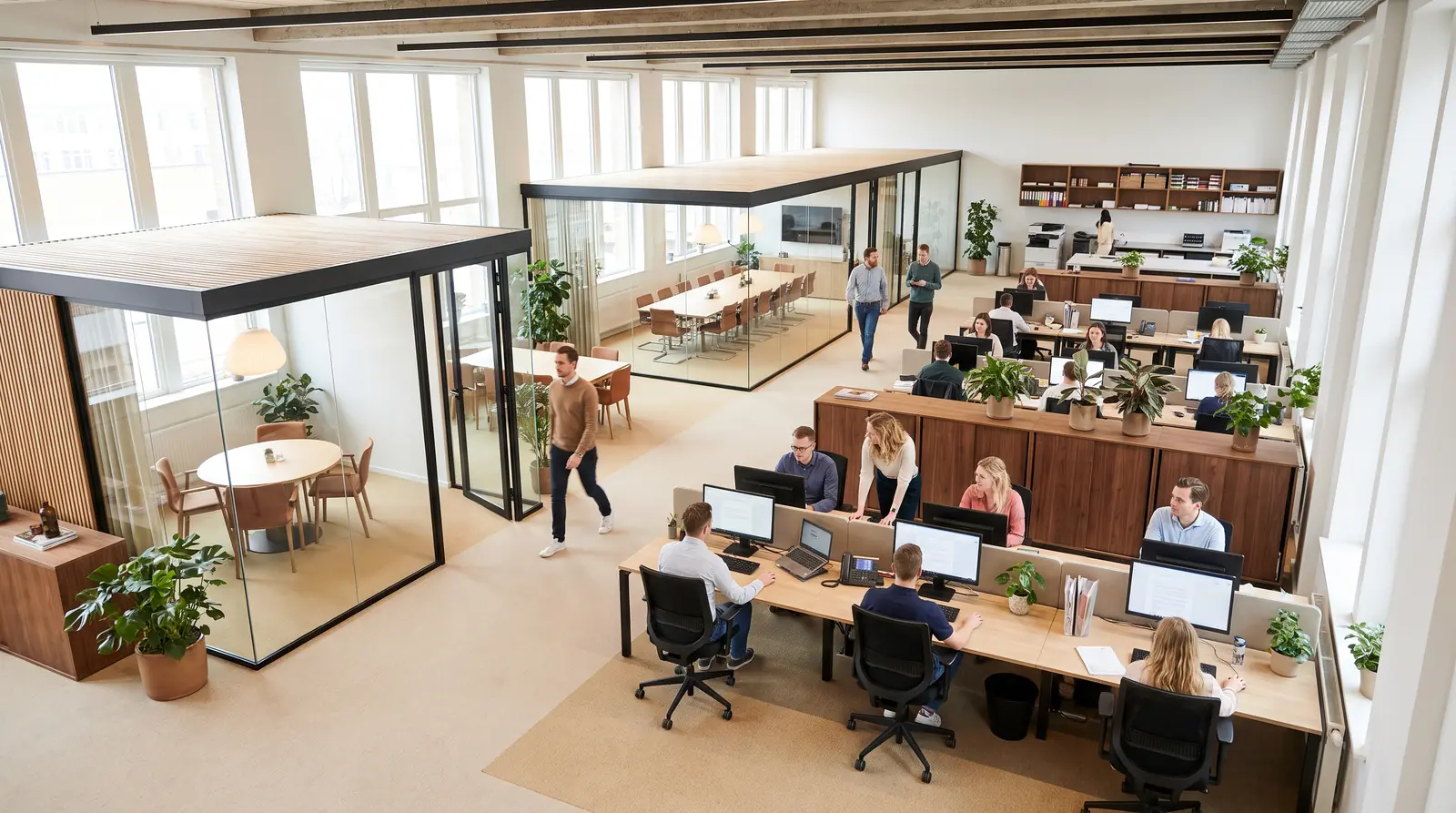
Open office areas with shared workstations (flex/fixed desks), lounges and community zones. For concentrated work, quiet zones and phone booths are used in addition. Open spaces form the heart of many coworking locations.
P – Plug & Play
Ready-to-use offices: furniture, IT, internet, meeting rooms and services are ready to go. Companies save time and can start being productive immediately.
Q – Quiet Zones
Quiet retreat areas for focused work or brief recovery. They increase productivity and mental health. Quiet zones are an important element for work-life balance in the office.
R – Remote Work
Location-independent working outside the classic office. Requires digital infrastructure, clear team rituals and suitable space options (e.g. day pass, meeting room on demand). Remote work is today an integral part of hybrid working strategies.
S – Space-as-a-Service
Not just space, but a package of services (e.g. cleaning, reception, IT support) on a flexible contract basis. Companies thus rent complete working solutions instead of just rooms. Space-as-a-Service stands for maximum adaptability.
T – Traditional Office
Long-term leases, fixed space, self-managed fit-out and operation. Offers maximum control, but low adaptability – today often in combination with flexible models. Traditional offices are predictable, but less agile.
U – User-Centric Workspace
User-centric planning: ergonomics, choice, good acoustics, light, indoor climate and services (e.g. coffee/wellbeing). The goal: a better experience, higher loyalty and performance. User-centric workspaces put people at the centre of office design.
V – Virtual Office / Business Address
Business address, mail service and, optionally, telephone answering without a fixed workstation. Meeting rooms can be booked by the hour – ideal for distributed teams and a professional presence. Virtual offices combine professionalism with maximum flexibility.
W – WeWork
WeWork comes from New York and has just under 600 locations worldwide. In Germany, the Americans are present in Hamburg, Berlin, Frankfurt and Munich. They offer both flex and fixed desks as well as private offices, including for teams of up to 500 employees. WeWork has strongly shaped the coworking world and made it globally known.
X – Experience Spaces
Experience-oriented working environments that combine brand, technology and spatial design. The goal: to spark creativity, make identity tangible, intensify collaboration. Experience spaces are a flagship for innovative companies.
Z – 24/7 Access
Many coworking spaces offer 24/7 access. Keys or keycards are therefore often issued to members. In some spaces there are also fixed opening hours. Round-the-clock access increases flexibility and adapts to international teams or individual working rhythms.
Let's find your new Flex Office

Related posts


CoWorking Capital is a comparison portal for flex offices, business centres and coworking spaces with personal expert advice. We help companies across Germany evaluate office offers clearly, make well-founded decisions and find the right office.
